
Autonomous Forklift Vs Agv has become a practical question for warehouses planning smarter material handling in 2026. The answer depends on more than vehicle price or advertised automation levels. Facility layout, load types, traffic patterns, labor availability, and integration demands can change the result quickly. An autonomous forklift can pick, transport, and place pallets without a dedicated driver. An AGV usually follows mapped routes and performs repeatable movements with high consistency.
The difference becomes clear on the warehouse floor. A forklift may navigate changing pallet positions, uneven workflows, and mixed pedestrian areas. An AGV can excel between fixed stations, conveyor lines, and predictable storage points. Safety scanners, emergency stops, fleet software, charging systems, and operator training also deserve close attention. A reliable evaluation should compare payload capacity, lifting height, turning radius, travel speed, battery endurance, and recovery procedures. Vendor demonstrations are useful, but they are not enough. Real testing should include peak shifts, blocked aisles, damaged pallets, and unexpected human movement.
Conditions matter most.
Industry experience shows that the cheapest system is not always the lowest-cost system. Installation work, software integration, maintenance access, and downtime can reshape the five-year investment. Some warehouses may need a hybrid fleet instead. That option is less elegant, perhaps, but often more practical. This guide examines the strengths, limitations, safety considerations, and operating costs of each technology. It also questions common marketing claims, helping decision-makers choose equipment based on measurable performance rather than impressive demonstrations.
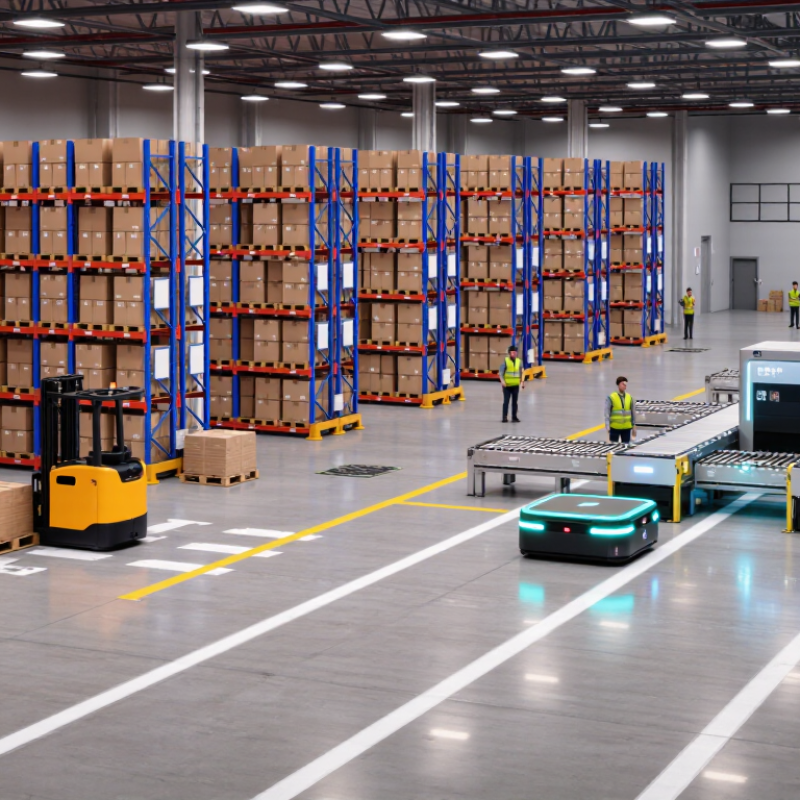
Autonomous forklifts are industrial vehicles that move, lift, and place pallets with limited human control. They use cameras, lidar, sensors, onboard software, and digital maps to understand their surroundings. Some models collect a pallet from a floor location and place it into a rack. Others deliver loads between production areas and storage zones. They can slow down near workers, stop for obstacles, and adjust their path when conditions change. Still, they need clear operating rules and trained supervisors.
AGVs, or automated guided vehicles, usually transport materials along planned routes. These routes may use magnetic tape, reflectors, wires, QR markers, or mapped navigation. An AGV can carry a loaded platform, tow carts, or support repetitive warehouse transfers. Traditional AGVs often follow fixed guidance more strictly than autonomous forklifts. They may stop when a pallet blocks the route instead of finding another path. They are not identical.
The difference becomes visible on a busy warehouse floor. An autonomous forklift may approach a pallet from a new angle, while an AGV may wait for the route to clear. However, the boundary is not always clean. Modern systems combine route planning, sensors, and fleet software. A practical evaluation should check floor quality, rack dimensions, pallet consistency, traffic patterns, safety zones, and software integration. A pilot test can reveal problems that a sales specification misses. Sometimes, the simplest route is not the safest one.
Typical capability comparison based on common industrial system designs
Autonomous forklifts are designed to pick up, transport, and place palletized loads, including storage and retrieval tasks. AGVs typically follow predefined routes or controlled navigation paths and are widely used for repeatable material transport, towing, and line-side delivery. The scores use a typical 1–5 capability index, where 5 represents stronger suitability for the listed application.
Autonomous Forklift vs AGV: Which Is Better in 2026?
Autonomous forklifts combine lidar, cameras, safety scanners, and onboard software. These systems build a warehouse map and localize themselves during movement. They can approach pallets, adjust their forks, and place loads at changing locations. AGVs usually follow fixed routes, magnetic tape, reflectors, or programmed checkpoints. Some newer AGVs use navigation sensors, but their decisions remain more limited.
The difference becomes visible on the warehouse floor. An autonomous forklift can reroute around a fallen carton or a temporary work zone. An AGV may stop and wait for route clearance. Fleet software assigns missions, controls traffic, and records completed moves. Human operators still matter during unusual pallet conditions. They also verify safety zones and loading accuracy. Small errors can become expensive.
The International Federation of Robotics reported 113,000 professional service robots installed for transportation and logistics in 2023, a 24% annual increase (World Robotics 2024). MHI’s 2024 Annual Industry Report also identifies robotics and automation as major supply-chain investment priorities. Cost, aisle design, pallet variation, and integration quality decide the better choice. Fixed routes can be cheaper and easier to validate. Flexible navigation can deliver more value in changing operations. Not every “autonomous” vehicle performs autonomously in practice. Metrics should include intervention rates, missed pickups, charging time, and near-miss events. A clean demonstration is not enough.
| Comparison Dimension | Autonomous Forklift | AGV (Automated Guided Vehicle) |
|---|---|---|
| Basic Definition | A driverless industrial truck designed to lift, transport, stack, or retrieve palletized loads. | A mobile robot that follows a defined route or guidance system to transport materials, usually without a lifting mast. |
| Typical Load Capacity | Approximately 1,000–3,000 kg for common pallet-handling applications; specialized models may support more. | Approximately 500–2,000 kg for common pallet or tugger applications; capacity depends on vehicle and trailer design. |
| Primary Material-Handling Tasks | Pallet pickup and drop-off, floor stacking, rack storage, truck loading and unloading, and warehouse replenishment. | Point-to-point transport, line-side delivery, pallet movement, cart towing, and repetitive route-based transfers. |
| How Navigation Works | Commonly uses laser scanners, cameras, 3D sensors, inertial sensors, reflectors, maps, and real-time localization. | May use magnetic tape, wires, QR codes, reflectors, laser guidance, or natural-feature navigation, depending on the AGV design. |
| Route Flexibility | High. Digital routes can usually be adjusted for changing storage layouts and operating conditions. | Low to medium for fixed-path systems; medium to high for laser- or map-guided systems. |
| Lifting and Stacking | Yes. Designed for fork insertion, pallet lifting, stacking, and in some cases rack placement. | Usually no. A standard AGV transports loads on a deck or pulls a trailer; lift-deck AGVs are an exception. |
| Typical Operating Speed | Commonly about 1–2 m/s when unloaded or lightly loaded; speed is reduced during turning, lifting, or congested operation. | Commonly about 0.5–2 m/s, depending on load, route design, traffic, floor conditions, and safety requirements. |
| Load-Handling Precision | Suitable for pallet alignment and placement; performance depends on pallet condition, rack tolerances, sensors, and floor accuracy. | Generally precise for repeatable transfer points, but load pickup may require dedicated stations or accurate pallet presentation. |
| Human Interaction | Can share warehouse areas with pedestrians when equipped with appropriate detection, warning, and protective systems. | Can operate near people, but intersections, crossing points, and fixed routes require carefully designed safeguards. |
| Safety Technologies | Safety laser scanners, 3D cameras, speed control, obstacle detection, audible or visual alerts, emergency stops, and load monitoring. | Safety scanners, bumpers, emergency stops, warning lights, audible alarms, speed zones, and route-control logic. |
| Battery and Charging | Lead-acid, lithium-ion, or other industrial battery systems; opportunity charging and automatic charging are common options. | Lead-acid or lithium-ion batteries are common; charging may be scheduled, automatic, or performed during idle periods. |
| Installation Requirements | Requires mapped operating zones, pallet standards, safety assessments, suitable floor conditions, and integration with warehouse processes. | Requires defined routes or mapped areas, transfer stations, traffic controls, charging points, and interfaces with production or warehouse systems. |
| Best-Fit Environment | Warehouses and distribution centers with frequent pallet movement, variable destinations, stacking, and limited operator availability. | Factories and warehouses with stable, repetitive material flows between predefined pickup and delivery points. |
| Layout Change Tolerance | Typically better for changing layouts when the navigation map and operating rules can be updated digitally. | Fixed-path systems may require physical guide changes; software-guided AGVs generally handle changes more easily. |
| System Integration | May integrate with warehouse management systems, warehouse control systems, storage equipment, conveyors, and dock operations. | May integrate with manufacturing execution systems, warehouse systems, conveyors, elevators, doors, and automated storage equipment. |
| Main Advantages | Combines autonomous navigation with forklift functions, reduces manual driving, and supports direct pallet handling. | Provides predictable transport, repeatable workflows, and efficient movement over established routes. |
| Main Limitations | Higher system complexity, stricter pallet and floor requirements, and more demanding safety validation than simple transport vehicles. | Less suitable for unstructured tasks, direct rack stacking, and environments where routes or pickup conditions change frequently. |
| Which Is Better? | Better when autonomous pallet lifting, stacking, and flexible warehouse navigation are the main priorities. | Better when the operation mainly requires reliable, repetitive transport along clearly defined routes. |
Note: Specifications are typical industry ranges and operating characteristics. Actual performance depends on vehicle configuration, load dimensions, battery technology, floor quality, traffic conditions, safety requirements, and site layout.
Key Differences in Navigation, Load Handling, and Flexibility
Autonomous forklifts usually navigate with lidar, cameras, and natural feature mapping. They can detect racks, pallets, workers, and temporary obstacles. Their routes may change when a staging area moves. That matters in warehouses with mixed traffic and changing order patterns. An AGV often follows magnetic paths, QR markers, reflectors, or carefully mapped routes. This can deliver stable movement, but route changes may require more planning and site adjustments. Neither method is automatically better.
Load handling creates a sharper difference. An autonomous forklift can approach a pallet, align its forks, lift it, and place it at different heights. It suits pallet movement between receiving docks, storage aisles, and production zones. An AGV usually carries, tows, or transfers a defined load. It may need precise pickup stations and consistent pallet positions. Small errors can stop the process. Real warehouses are rarely perfect.
Flexibility also depends on supervision, floor conditions, and traffic rules. Autonomous forklifts may handle changing tasks, but their sensors can struggle with dust, glare, damaged pallets, or crowded aisles. AGVs can be easier to control in repetitive lanes, especially where traffic is predictable. Yet fixed routes may become a limitation during expansion. A useful evaluation should measure pickup accuracy, recovery time, charging needs, and operator interaction. Short trials often reveal problems that specifications overlook.
Autonomous forklifts and AGVs solve different warehouse problems.
The better choice depends on workflow, floor design, and handling needs. Autonomous forklifts suit pallet storage, trailer unloading, and variable routes. Their sensors can identify rack positions and adjust around people or obstacles. They also handle lifting tasks, not only transport. In a high-bay warehouse, this can reduce repeated manual travel and improve pallet consistency. Yet performance depends on accurate maps, clear safety zones, and disciplined charging routines. It is not magic.
AGVs often fit stable, repeatable movements between production lines, docks, and staging areas.
They follow defined paths and can move carts, pallets, or containers with predictable timing. This makes them practical for warehouses with fixed lanes and consistent loads. AGVs may be easier to schedule when processes rarely change. However, changing layouts can require route updates and operational testing. A rushed deployment may create queues near shared intersections. That lesson is easy to miss.
Tips:
Measure task frequency, payload, aisle width, floor condition, and peak traffic before choosing. Test one live route during a busy shift. Record stops, near-conflicts, charging delays, and operator feedback. For mixed operations, combining both systems may work better than forcing one technology everywhere. Human oversight still matters.
Choosing between an autonomous forklift and an AGV in 2026 starts with your operation, not the technology’s popularity. An autonomous forklift suits facilities with pallet pickup, stacking, and changing storage locations. It can approach racks and adjust to variable loads. An AGV works better when transport routes are stable and repeatable. It moves materials between fixed points with predictable timing.
Walk through the site before selecting equipment. Measure aisle width, floor quality, pallet consistency, pedestrian movement, and loading heights. Check whether your warehouse system can exchange accurate task data. Safety sensors matter, but safe deployment also requires clear traffic rules and trained employees. From practical evaluations, small layout changes can affect performance more than advertised travel speed. A pilot may reveal weak barcode placement, uneven floors, or charging delays. That is useful, although it can challenge the original plan.
Tips: Define the main bottleneck first. Compare completed moves per hour, not vehicle speed alone. Test full and damaged pallets. Record stoppages, recovery time, and operator intervention. Ask maintenance teams whether they can support daily inspections and fault response. Consider future changes, too. An AGV may be economical today, but costly when routes expand. An autonomous forklift may offer greater flexibility, yet require more careful safety validation and integration. No option wins every test. Your best choice should match current workflows while leaving room for honest improvement.
It moves, lifts, and places pallets with limited human control. It uses cameras, lidar, sensors, maps, and onboard software. A trained supervisor still matters.
An AGV transports materials along planned routes. It may follow magnetic tape, wires, reflectors, QR markers, or digital maps. Many AGVs carry platforms, carts, or containers.
Autonomous forklifts can change direction and handle lifting tasks. AGVs usually follow defined routes and transport set loads. The boundary is not perfectly clear.
Autonomous forklifts usually adapt better when staging areas or traffic patterns change. They can approach pallets from different angles. Sensors may still struggle with glare, dust, or crowded aisles.
AGVs suit stable operations with repeatable lanes and consistent loads. They can move carts between production lines and staging areas. Predictable work helps.
Yes, many models collect floor pallets and place them at different rack heights. They need accurate maps, suitable aisles, and consistent pallet positions. Small errors can stop the process.
Check floor quality, aisle width, rack dimensions, pallet condition, and traffic flow. Also review safety zones, charging areas, and software connections. Real floors are rarely perfect.
Run one live route during a busy shift. Record stops, near-conflicts, charging delays, pickup accuracy, and recovery time. Ask operators what went wrong. Specifications can miss practical problems.
No. Autonomous forklifts may suit mixed tasks and variable routes. AGVs may suit repetitive transfers with fixed lanes. Combining both can work, but coordination may become difficult.
In 2026, the comparison between Autonomous Forklift Vs Agv focuses on how each solution supports safer, more efficient warehouse operations. Autonomous forklifts combine automated navigation with the ability to pick up, move, and place palletized loads, making them suitable for repetitive transport and storage tasks. AGVs, or automated guided vehicles, generally follow predefined routes or digital guidance systems to move materials between designated locations. Both technologies can reduce manual handling, improve workflow consistency, and operate alongside warehouse management systems.
The key differences involve navigation, load handling, flexibility, and deployment requirements. Autonomous forklifts are often better for dynamic environments that require pallet handling and adaptable travel paths, while AGVs may be more practical for stable, predictable routes and continuous material movement. The right choice depends on warehouse layout, load types, traffic conditions, required flexibility, integration needs, safety objectives, and long-term operating costs. Careful process analysis and future growth planning can help businesses select the most suitable automation approach.