
How to Choose Autonomous Forklift vs Manual Forklift?
Choosing the right forklift affects safety, productivity, labor planning, and long-term operating costs. The decision is rarely as simple as comparing purchase prices. Warehouse layout, aisle width, floor conditions, traffic patterns, load types, and operator availability all influence the result. This is where Autonomous Forklift Vs Manual Forklift becomes a practical business evaluation, not merely a technology debate.
An autonomous forklift can move repeated loads along predictable routes, using sensors, software, and mapped workflows. It may reduce routine driving demands and provide more consistent material movement. However, it requires suitable infrastructure, reliable system integration, and trained staff who can manage exceptions. Manual forklifts offer flexibility when loads, routes, or priorities change quickly. They can also be easier to introduce in smaller facilities, although productivity may vary between operators.
Real warehouse conditions often challenge both options. A narrow aisle, a damaged pallet, or a temporary storage area can disrupt an autonomous route. Manual operation may solve that problem quickly, but it introduces greater dependence on human attention and behavior. That assumption can be wrong. A careful site assessment should examine traffic records, loading frequency, maintenance needs, and emergency procedures before selecting equipment. Pilot testing is valuable, especially during peak shifts and mixed-traffic periods. No option is perfect. The strongest choice matches the forklift to measurable operational needs, realistic workforce capabilities, and future growth rather than following industry excitement alone.
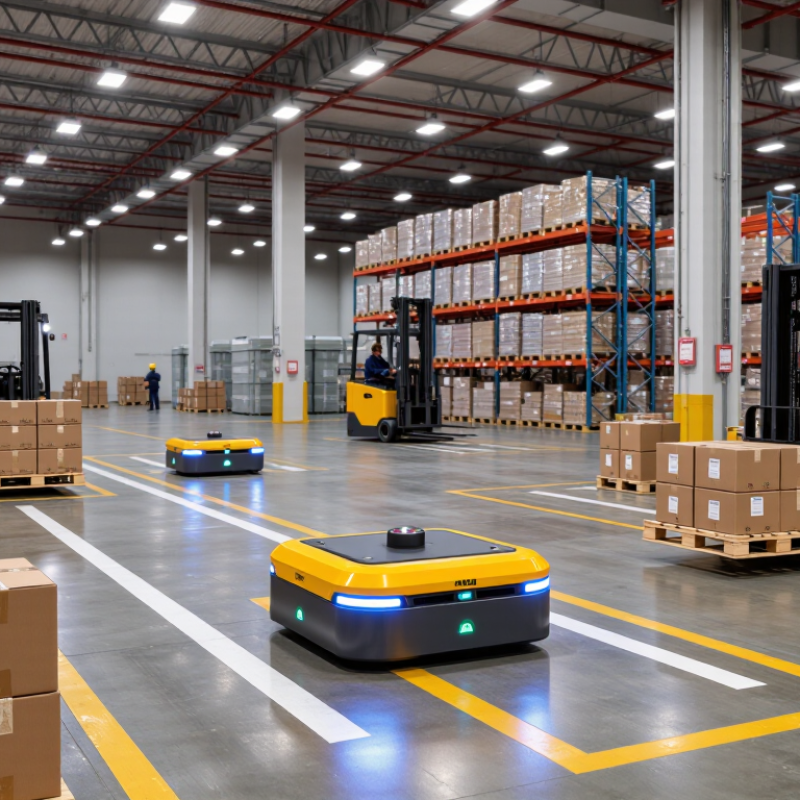
Understand the Core Differences Between Autonomous and Manual Forklifts
How to Choose Autonomous Forklift vs Manual Forklift?
Choosing between an autonomous forklift and a manual forklift starts with their core operating differences. A manual forklift depends on a trained operator for steering, lifting, hazard awareness, and route changes. An autonomous forklift uses sensors, software, and mapped routes to perform repeatable movements. It can pause near a person, pallet, or obstruction. However, it may not understand every unusual situation like an experienced operator. That matters.
Manual forklifts offer flexible decision-making in changing warehouse conditions. An operator can handle irregular pallets, temporary storage areas, and unexpected loading tasks. They can also judge damaged packaging more carefully. Autonomous forklifts usually perform better on stable routes, repeated transport cycles, and predictable floor layouts. They may reduce routine driving and improve movement consistency. Not always. Poor mapping, blocked paths, or inconsistent pallets can reduce their value quickly.
The practical difference also appears in workforce planning and site preparation. Manual equipment needs qualified operators, daily inspections, and clear visibility around traffic zones. Autonomous equipment needs accurate maps, maintained sensors, reliable charging areas, and trained staff for exception handling. A warehouse trial should measure cycle time, stopping accuracy, aisle width, and pallet variation. Choosing automation only because it looks modern can be a costly mistake. A mixed fleet may fit better when repetitive transport exists beside frequent human judgment. Warehouses change, sometimes faster than plans.
How to Choose Autonomous Forklift vs Manual Forklift? - Understand the Core Differences Between Autonomous and Manual Forklifts
| Evaluation Dimension | Autonomous Forklift | Manual Forklift | Selection Consideration |
|---|---|---|---|
| Primary Operating Method | Performs programmed transport, pallet movement, or put-away tasks with limited direct operator input. | A trained operator continuously controls steering, travel, lifting, and load placement. | Choose autonomous operation for repeatable workflows; choose manual operation for frequent human judgment and variation. |
| Typical Use Case | Repetitive pallet transport between defined locations, warehouse replenishment, production-line supply, and trailer or staging-area transfers. | Mixed warehouse work, irregular loading, variable pallet conditions, construction-related handling, and tasks requiring frequent repositioning. | Map the percentage of daily forklift travel that follows repeatable routes and standard load-handling steps. |
| Operator Requirement | Usually does not require a dedicated driver during autonomous travel, but trained personnel are still needed for supervision, exception handling, maintenance, and safety checks. | Requires a trained and authorized forklift operator for each operating shift or work assignment. | Autonomy can reduce driving labor demand, but it does not eliminate operational or safety responsibilities. |
| Navigation Method | May use facility maps, natural-feature navigation, magnetic or visual markers, reflectors, QR-style references, or other site-specific guidance technologies. | The operator navigates using visual judgment, floor markings, signs, aisle geometry, and standard traffic controls. | Autonomous systems require a suitable facility layout, reliable localization, and clearly defined traffic rules. |
| Operating Speed | Typically operates at controlled speeds that may be lower than the maximum speed of a manually driven truck, especially near people and intersections. | Speed is controlled by the operator and is generally limited by the truck specification, site rules, load, visibility, and pedestrian conditions. | Compare complete cycle time rather than maximum travel speed, including waiting, turning, loading, unloading, and safety stops. |
| Load Capacity | Common autonomous counterbalanced and pallet-handling models are often designed for approximately 1,000–3,000 kg, depending on configuration. | Manual forklifts are available across a broad range, from compact warehouse trucks to heavy-duty models exceeding 10,000 kg. | Select by actual load weight, load center, attachment type, lift height, and residual capacity—not rated capacity alone. |
| Lift Height and Load Placement | Suitable for standardized pick-up and drop-off heights; unusual pallet positions or obstructed loads may require human intervention. | The operator can make real-time adjustments for uneven pallets, variable rack positions, and non-standard placement conditions. | Autonomy is strongest when pallet dimensions, rack locations, and handoff points are consistent. |
| Flexibility | Moderate flexibility; route and task changes may require software updates, remapping, workflow changes, or engineering support. | High flexibility; an operator can usually respond immediately to changing priorities, blocked aisles, unusual loads, and temporary work areas. | Manual forklifts are generally better for highly variable operations and rapidly changing layouts. |
| Safety Features | Typically combines obstacle detection, speed reduction, protective zones, emergency stopping, warning indicators, and controlled interaction with pedestrians. | Relies heavily on operator training, visibility, seat-belt use, traffic procedures, pedestrian awareness, and regular equipment inspections. | Neither option is automatically safe; facility design, procedures, training, maintenance, and risk assessment remain essential. |
| Performance Consistency | Provides consistent execution for predefined tasks and can support scheduled operation across multiple shifts. | Performance varies with operator skill, fatigue, workload, traffic congestion, and shift staffing. | Autonomy is more valuable when stable cycle times and predictable service levels are important. |
| Throughput Potential | Can improve throughput by reducing idle travel, coordinating tasks, and operating during low-staffing periods, provided the workflow is well designed. | Can achieve high throughput when skilled operators are available and the work requires rapid decisions or flexible movement. | Estimate throughput from actual task demand and congestion; automation does not compensate for bottlenecks at docks, racks, or production stations. |
| Battery and Charging | Often designed for opportunity charging, automated charging, or scheduled battery changes, depending on the vehicle and duty cycle. | May use lead-acid, lithium-ion, or other approved battery systems; charging and battery changes are normally managed by personnel. | Evaluate shift length, charging space, ventilation requirements, battery handling, and available electrical capacity. |
| Initial Investment | Usually higher because the solution may include sensors, control software, safety infrastructure, integration, site preparation, and commissioning. | Usually lower at the time of purchase because the truck generally requires less automation infrastructure. | Compare total cost of ownership rather than purchase price alone. |
| Labor Cost Impact | May reduce direct driving labor for repetitive movements, while increasing requirements for supervision, system support, and technical maintenance. | Requires ongoing operator labor for each active truck and shift. | Calculate savings using actual labor hours, overtime, turnover, training, and expected equipment utilization. |
| Facility Requirements | Benefits from stable aisle widths, clear travel paths, reliable floor conditions, defined handoff areas, and controlled pedestrian interaction. | Can generally adapt more easily to temporary obstructions and changing work areas, subject to safe operating limits. | Audit floor quality, aisle geometry, lighting, traffic patterns, rack layout, and pedestrian crossings before implementation. |
| System Integration | May integrate with warehouse management, warehouse control, manufacturing execution, fleet-management, dock, conveyor, or automatic door systems. | Usually depends on operator instructions, radio communication, paper processes, or existing warehouse software rather than direct vehicle orchestration. | Confirm data interfaces, task-release logic, exception handling, cybersecurity, and responsibility for system support. |
| Exception Handling | Stops or requests assistance when it encounters an unexpected obstacle, misplaced pallet, unavailable destination, or unsafe condition. | The operator can often recognize and resolve exceptions immediately, within the limits of training and site procedures. | Measure exception frequency; a high exception rate can reduce the business case for full autonomy. |
| Maintenance and Support | Requires conventional forklift maintenance plus attention to sensors, software, communications, maps, safety scanners, and charging systems. | Requires routine mechanical, hydraulic, electrical, tire, mast, attachment, and battery maintenance. | Check local service capability, spare-parts availability, response times, and preventive-maintenance requirements. |
| Best-Fit Operating Profile | High-volume, repetitive, predictable, labor-intensive, and multi-shift operations with standardized loads and routes. | Low-to-medium volume, variable, non-standard, frequently changing, or highly judgment-dependent operations. | Many facilities benefit from a hybrid fleet that assigns autonomous trucks to repeatable routes and manual trucks to flexible tasks. |
Note: Specifications, operating speeds, capacities, integration requirements, and total costs vary by vehicle configuration, facility design, load type, duty cycle, and applicable local safety regulations.
FAQS
Consider one when pallets follow repeated routes every day. Fixed movement patterns are easier to automate. Clear aisles help. Run a controlled pilot before making a full purchase.
Manual control may suit irregular loads, changing layouts, and occasional pallet movements. Human judgment helps around crowded areas and unexpected obstacles. Flexibility matters. The best choice can change during seasonal demand.
Record travel distances, pallet weights, aisle widths, floor quality, traffic, and shift length. Also inspect ramps, lighting, blind corners, and charging access. Small details matter. A damaged floor can create repeated stoppages.
Test both options during a busy shift. Measure completed moves per hour, stoppage minutes, labor availability, and near misses. Observe real work, not only demonstrations. A two-week study may reveal awkward delays.
No. Staff must monitor alerts and approve unusual movements. They should stop operations when routes change or obstacles appear. Automation is not independence. A blocked aisle can still disrupt decisions.
Training should cover load balance, limited visibility, pedestrian awareness, and emergency controls. Workers should practice turning beside racks and crossing uneven or wet floors. Classroom learning alone is insufficient. Observed competence matters more.
Use clear floor markings, separated pedestrian routes, reliable sensors, and regular maintenance. Check crossings, blind corners, lighting, and ramps before testing. Keep routes visible. A loose strap can confuse equipment.
Review pilot results with operators, supervisors, and safety specialists. Document exceptions, including awkward pallets and sudden layout changes. Their feedback may challenge the original plan. That is useful.
Conclusion
Choosing between an Autonomous Forklift Vs Manual Forklift requires a clear understanding of how each option fits your warehouse environment. Autonomous forklifts can support repetitive material movement with consistent accuracy, reduced direct labor, and improved workflow continuity. Manual forklifts, however, offer greater flexibility for changing tasks, unusual loads, and operations that require immediate human judgment. The right choice depends on warehouse size, traffic patterns, task frequency, load characteristics, floor conditions, and the level of human oversight available.
Safety, training, cost, productivity, and system integration should all be evaluated before making a decision. Autonomous equipment may require higher initial investment and careful setup, while manual equipment typically involves more operator training and ongoing labor dependence. Consider whether your facility needs scalable automation, rapid task changes, or compatibility with existing warehouse systems. By comparing present demands with long-term operational goals, businesses can select the forklift type that improves efficiency, supports safe working practices, and delivers sustainable value.
