
Featured Industrial Autonomous Forklifts & AGV Systems
Direct factory-engineered Laser SLAM driverless forklifts, counterbalanced vehicles, and intelligent stacking units delivering ±5mm high-precision material routing.





Global Landscape: The Paradigm Shift from Static AGV to Natural Feature LGV
How Chinese high-precision robotics manufacturing is reshaping global intralogistics through natural contour navigation, modular mechatronics, and rapid factory commissioning.
The contemporary intralogistics and automated manufacturing sectors are experiencing an unprecedented operational evolution. For decades, legacy manufacturing infrastructures relied heavily on conventional Automated Guided Vehicles (AGVs) tethered to static physical markers—such as magnetic guidance tapes, floor-embedded inductive wires, or fixed optical barcodes. While these earlier generations provided rudimentary point-to-point automation, their architectural fragility exposed global supply chains to exorbitant maintenance costs, rigid operational floor plans, and protracted downtime whenever logistics workflows required recalibration.
Today, the convergence of high-frequency pulsed LiDAR systems, advanced edge computing, and spatial algorithmic software has catalyzed the widespread adoption of Laser Guided Vehicles (LGVs) and Natural Feature Laser SLAM (Simultaneous Localization and Mapping) AMRs. Headquartered in Chengdu, China, SCP Technology (Sichuan Supply Chain Power Chain Technology Co., Ltd.) stands at the direct nexus of this technical renaissance, operating as a Tier-1 industrial robotics manufacturer and enterprise partner across 30+ international trade corridors.
Legacy Guided AGV Platforms
Guidance Method: Magnetic floor tape, sub-surface wire induction, optical floor fiducials.
Commissioning Overhead: High (4 to 12 weeks of concrete trenching, magnetic track mapping, and site closure).
Dynamic Obstacle Handling: Minimal. Vehicles execute hard stops upon infrared beam severance, causing traffic bottlenecks.
Reconfiguration Agility: Rigid. Moving a pickup terminal requires physical re-taping and software re-indexing.
Damaged Floor Sensitivity: High. Abrasion, chemical washdowns, and heavy tire traffic rapidly degrade optical strips.
SCP Laser SLAM LGV Architecture
Guidance Method: Infrastructure-free Natural Contour Navigation & Hybrid Multi-Layer 3D LiDAR SLAM.
Commissioning Overhead: Ultra-Low (1-day zero-retrofit deployment; digital floor plan mapping up to 400,000 m²).
Dynamic Obstacle Handling: Autonomous real-time path re-routing using stereoscopic 3D vision and reactive clearance vectors.
Reconfiguration Agility: Dynamic software-defined re-mapping via Server X Store fleet controllers and open API endpoints.
Operational Precision: Repeatable ±5 mm docking precision with automatic pallet pocket distortion recognition.
The Chinese Manufacturing Ecosystem Advantage
China's ascendancy as the global epicenter for advanced mobile robotic manufacturing is grounded in complete upstream and downstream vertical integration. The industrial synergy encompassing cycloidal pinwheel reducers, ultra-dense rare-earth permanent magnet synchronous motors (PMSM), and domestic micro-machined LiDAR sensor packages enables Chinese manufacturers to compress production cycles while maintaining rigorous mechanical tolerances. SCP Technology leverages this advanced manufacturing base to build heavy-duty cast chassis, rigid triplex masts, and automotive-grade wiring harnesses, delivering machines that seamlessly endure continuous 24/7 operating regimes across harsh global industrial environments.
Full-Stack Control Architecture: The SCC Motion Engine
Integrating embedded hardware controllers, multi-sensor perception stacks, and enterprise fleet orchestration systems into a unified material handling ecosystem.
At the operational core of every SCP automated machine sits the proprietary SCC Embedded Industrial Controller. Engineered for real-time determinism, the SCC controller harmonizes sensory ingress from navigation LiDARs, safety scanners, wheel odometry encoders, and inertial measurement units (IMUs) through an internal Kalman filter matrix executing at microsecond intervals.
Rather than functioning merely as an isolated vehicle, each SCP automated forklift operates as an intelligent edge node. Integrated directly with our Server X Store Fleet Dispatch Engine, vehicles autonomously negotiate crossing points, dynamic right-of-way assignments, elevator interactions, and automated rapid-charging intervals without requiring constant manual dispatcher intervention.

AI Perception & 3D Vision
Dual-depth cameras identify skewed, damaged, or misaligned pallets, dynamically adjusting fork tine trajectory before initial engagement.
Hot-Swap Battery Mechanics
Automated opportunity charging via side contact shoes or rapid 2-minute physical battery pack swaps ensure uninterrupted 24/7/365 fleet runtime.
Multi-Tier Safety Shield
Integrated safety LiDARs configure dual dynamic warning zones, emergency stop detection, mechanical collision bumpers, and top-height acoustic alarms.
Digital Twin Simulation
Execute full-lifecycle fleet physics modeling prior to deployment to calculate cycle bottlenecks, traffic congestion points, and precise vehicle counts.
Industrial Application Scenarios & Realized Efficiencies
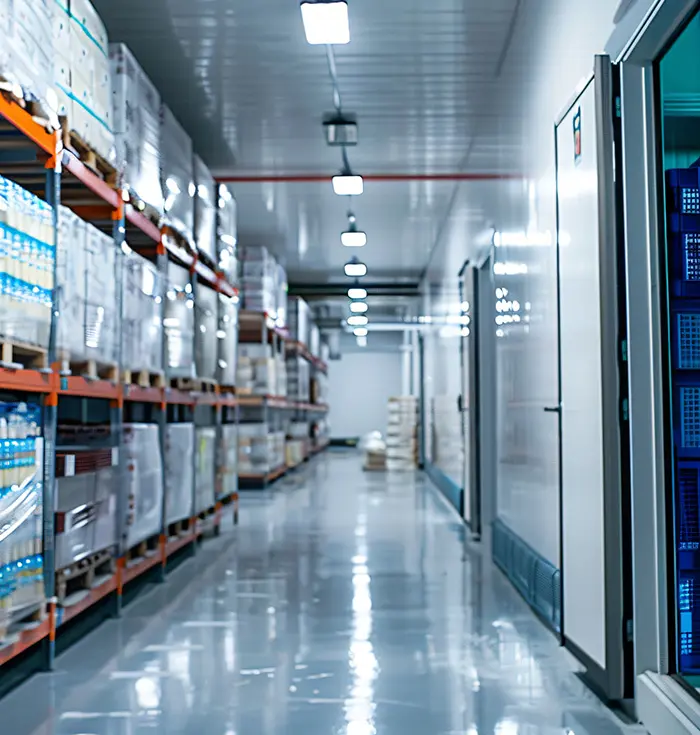
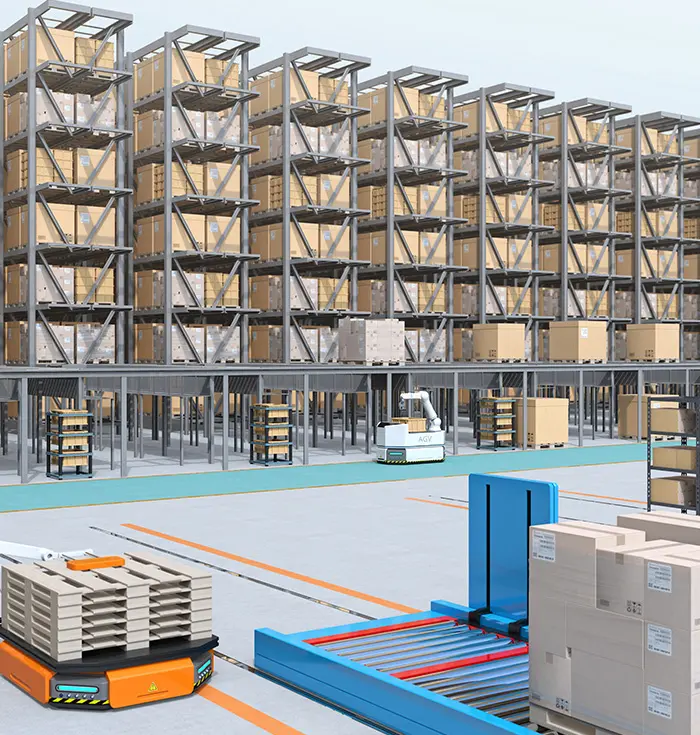
From automotive sub-assembly plants to cold-chain pharmaceutical vaults, review how SCP vehicles adapt to extreme operational dynamics.


International Compliance, Functional Safety & On-Site Support
Eliminating deployment risks for overseas buyers through rigorous international engineering certifications and localized technical service programs.
A primary friction point for international enterprise procurement teams acquiring automation machinery from China centers on regulatory divergence, cross-border documentation, and post-commissioning lifecycle maintenance. SCP Technology neutralizes these friction points through proactive alignment with European and North American functional safety directives.
Regulatory Safety Directives
- EN ISO 3691-4:2023: Full adherence to driverless industrial truck safety protocols, control system architecture validation, and clearance zones.
- CE Machinery Directive 2006/42/EC: Comprehensive third-party audited technical files, electromagnetic compatibility (EMC) testing, and low-voltage electrical safety.
- ANSI/ITSDF B56.5 & OSHA 1910.178: North American industrial truck operational compliance, warning light sequencing, and dynamic braking distances.
- Functional Safety PL-d / SIL 2: Redundant dual-channel safety relays, certified safety PLCs, and failsafe mechanical service brakes.
Worldwide Localized Support Matrix
- Remote Cloud Diagnostics: Secure 24/7 telemetry channels allowing senior factory engineers in Chengdu to monitor vehicle CAN-bus status globally.
- Spares Warehousing: Regional warehousing for critical spare parts (drive units, LiDAR sensors, encoders, hydraulic valves) for rapid replacement dispatch.
- Certified Field Service Partners: Collaborating with regional systems integrators throughout North America, Western Europe, Southeast Asia, and the Middle East.
- Multi-Language Engineering Docs: Complete schematics, commissioning handbooks, API integration manuals, and operator training curriculum.
By marrying industrial-grade fabrication with global compliance certifications, SCP Technology ensures overseas procurement committees, plant safety directors, and operations executives can deploy Chinese autonomous handling solutions without regulatory hesitation or insurance pushback.
Technology Roadmap: The Convergence of AI Swarms & 3D Solid-State LiDAR
Examining the core research vectors that will define industrial autonomous mobility over the coming decade.
5G Private URLLC Slicing
Ultra-Reliable Low-Latency Communication protocols reducing wireless packet ping jitter below 1ms, enabling cloud-centralized trajectory computations across thousands of collaborating AGVs.
Multimodal Neural SLAM
Transitioning from 2D point cloud projections to NeRF-based (Neural Radiance Fields) continuous volumetric mapping, enabling robots to navigate complex facilities with changing ambient visual cues.
VDA 5050 Universal Fleet Interop
Unified communication messaging standards allowing SCP automated vehicles, third-party mobile robots, and automated vertical lifts to operate harmoniously under a single master dispatch orchestrator.
3D Solid-State Flash LiDAR
Elimination of rotating mechanical laser mirrors in favor of monolithic solid-state optical chips, increasing shock resistance, MTBF reliability, and reducing device component mass.
Frequently Asked Questions for Overseas Procurement
Key engineering, procurement, and site integration queries answered directly by SCP Technology specialists.
How does SCP Technology’s Laser SLAM navigation achieve ±5 mm precision without floor reflectors or magnets?
What specific interface protocols are supported for enterprise WMS, MES, and ERP integration?
What is the realistic commissioning timeline for an international plant deployment?
Can SCP automated forklifts be switched to manual operator mode in emergency situations?
How does the vehicle navigate changes in pallet positions or dynamic seasonal inventory density?
What is the battery service life and what charging configurations are provided?
Specialized AGV Chassis, Heavy-Duty Pallet Trucks & High-Reach Stacking Units
Explore our full line of specialized mobile robotics chassis, narrow-turning-radius AGVs, and heavy-payload automated pallet stackers.




Accelerate Your Factory Intralogistics Transformation
Connect with SCP Technology’s senior systems engineers to request technical datasheets, CAD facility clearance evaluations, or a live virtual demonstration of our Laser SLAM autonomous fleet.