
Engineered Laser SLAM Palletizing & Handling Fleets
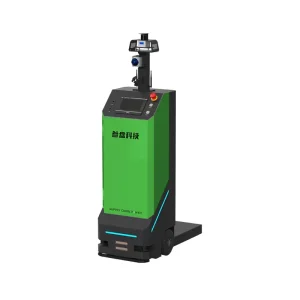
Direct-from-factory autonomous vehicles and robotic chassis engineered for rapid deployment, ±5 mm docking precision, and seamless multi-pallet recognition.

The Commercial Landscape of Robotic Palletizing & Material Handling
From fixed articulated arms to dynamic mobile autonomous palletizing: how contemporary supply chains are eliminating structural bottlenecks.
In modern industrial logistics, palletizing stands as the bridge between production synthesis and supply chain distribution. Across automotive manufacturing, fast-moving consumer goods (FMCG), pharmaceuticals, food and beverage processing, and heavy industrial chemical operations, the movement of palletized loads historically accounted for a high percentage of intralogistics operational expenditures. Manual forklift operations and fixed mechanical palletizers are increasingly unable to support dynamic, multi-SKU fulfillment requirements and rapid production changeovers.
According to comprehensive supply chain analytics, global investments in smart end-of-line palletizing and automated horizontal/vertical pallet transport have transitioned from a luxury of mega-factories to an operational necessity for mid-tier manufacturing facilities. The structural drivers of this shift include compounding industrial labor shortages across North America, Europe, and Asia-Pacific, rising workplace safety regulatory pressures (such as OSHA guidelines and European CE Machinery Directives), and an urgent market mandate to eliminate product damage during transport, which accounts for billions in recurring operational waste globally.
The contemporary standard for top-tier robotic palletizing infrastructure is no longer measured solely by pick-and-place cycle speed; it is defined by spatial flexibility, kinematic precision, fleet coordination intelligence, and low integration friction. Modern factories require robotic transport fleets that adapt to dynamic facility floor layouts on the fly, auto-negotiate path priorities with human workers, seamlessly interface with warehouse management systems (WMS) and manufacturing execution systems (MES), and deliver a verified Return on Investment (ROI) inside of 18 months.
Why Global Tier-1 Buyers Source from Chinese Robotic Factories
Analyzing the structural ecosystem advantages: hardware co-location, rapid prototyping cycles, and unmatched bill-of-materials cost optimization.
Complete Supply Chain Density
Chinese robotic manufacturing hubs integrate precision drive wheels, industrial servo motors, LiDAR sensors, and lithium iron phosphate (LiFePO4) battery systems within localized geographic corridors. This spatial density cuts component lead times from weeks to hours, allowing rapid turnaround on bespoke chassis dimensions, specialized fork geometries, and custom mast heights.
Rapid Iteration & Agile Engineering
Unlike traditional Western automation vendors burdened by legacy product platforms and slow re-engineering cycles, leading Chinese manufacturers maintain dedicated engineering squads that execute firmware tuning, kinematic calibration, and custom gripper or sensor integration within 14-day development sprints, lowering custom engineering expenses.
Superior TCO & Payback Velocity
By leveraging vertically integrated manufacturing lines, strict quality control (ISO 9001/ISO 3691-4), and scale economies, Chinese suppliers provide intelligent palletizing robots and autonomous forklifts at a 30% to 50% capital expenditure advantage over Western competitors, compressing payback horizons well below the standard 18-month threshold.
| Evaluation Parameter | Legacy Western Systems | Leading Chinese Robotic Factories (e.g. SCP Technology) |
|---|---|---|
| Navigation Infrastructure | Often relies on floor reflectors, optical tape, or physical tracks | Natural feature Laser SLAM; zero markers, tape, or facility retrofits |
| Initial Deployment Timeframe | 3 to 9 months with heavy civil engineering overhead | 1-day rapid calibration on compatible sites; multi-robot fleets within weeks |
| Software Interoperability | Proprietary architectures with expensive per-seat licensing | Open API ecosystem (RESTful, MQTT) with native WMS / MES / ERP integration |
| Docking & Handling Precision | ±15 mm to ±25 mm standard mechanical variance | ±5 mm industrial-grade docking via multi-sensor fusion and AI vision |
| Battery Maintenance & Uptime | Conventional lead-acid or fixed-charge cycles (downtime required) | Fast automated opportunistic charging + 2-minute rapid hot-swap modules |
Laser SLAM, Multi-Sensor Fusion & Vision-Guided Pallet Stacking
How advanced perception algorithms and edge computing controllers drive sub-centimeter robotic pallet engagement.
At the center of high-throughput automated pallet operations is real-time environmental awareness. Traditional AGVs that traverse fixed magnetic tracks fail as soon as an unexpected obstacle, oil spill, or pallet misalignment enters the workspace. Modern robotic pallet handling systems developed by engineering pioneers such as SCP Technology (Sichuan Supply Chain Power Chain Technology Co., Ltd.) combine multi-wavelength 2D/3D LiDAR, stereoscopic depth cameras, and inertial measurement units (IMU) through an ultra-low-latency sensor fusion layer.
1. AI Deep Learning Pallet Pocket Identification
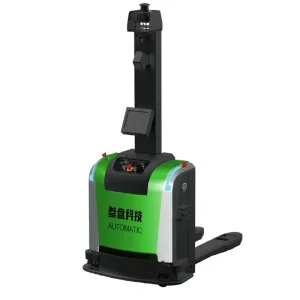
In high-speed operations, pallets rarely arrive in pristine, mathematically identical orientations. Wooden, plastic, and metal skid carriers experience sagging, broken stringers, and rotational skew on conveyors or drop-off pads. Modern autonomous forklifts (such as the SFL-CDD15 and SFL-CPD20-Y) feature tip-mounted 3D vision cameras paired with convolutional neural networks trained on millions of pallet variations. The system computes spatial posture vectors in real time, auto-adjusting fork spacing and entry angles to execute safe engagement without operator assistance.
2. Natural Feature Laser SLAM Across Massive Footprints
By capturing thousands of laser measurement points per second, the vehicle matches dynamic real-world features against a globally stored point cloud. SCP Technology's proprietary mapping algorithm allows a single autonomous robot to operate across complex facility floors spanning up to 400,000 square meters on a single coordinate map. Even when long warehouse aisles change as inventory levels fluctuate, the hybrid SLAM architecture seamlessly blends natural landmark recognition with wheel odometry and IMU tracking to guarantee steady, sub-centimeter reliability.
3. Multi-Layer Safety Architecture (ISO 3691-4 Compliant)
Safety is the primary metric in human-machine collaborative spaces. Leading palletizing robots feature a comprehensive, 360-degree safety envelope consisting of certified safety laser scanners, mechanical safety contact bumpers, dual emergency stop switches, and dynamic acoustic-optical alarm projections. When an obstacle or technician steps into the safety perimeter, the robot automatically switches from operational transit speed (up to 2.0 m/s) to staged deceleration, completely stopping prior to any physical impact.
Target Application Scenarios & System Integration
Field-tested implementations driving lights-out operational efficiency across complex manufacturing and distribution environments.
1. Manufacturing & Assembly Line-Side Feeding
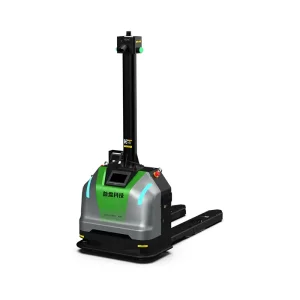
In high-speed automotive component, lithium battery, and electronics manufacturing, maintaining an uninterrupted line-side supply of raw materials while carting away finished sub-assemblies is critical. Compact autonomous mobile robot chassis (such as the AMB-CSW10-BH) slide beneath roller tables or specialized carts, lifting loads up to 1 ton to deliver JIT (Just-In-Time) materials synchronized directly with the facility's Manufacturing Execution System (MES).
2. High-Density Logistics & Distribution Centers
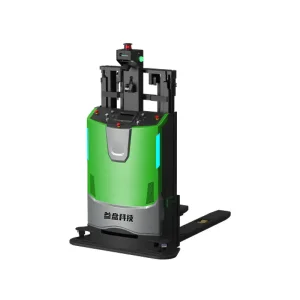
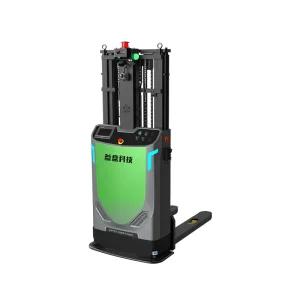
Large-scale e-commerce and third-party logistics (3PL) warehouses face severe peak-demand spikes. Heavy-duty counterbalanced smart forklifts (such as the SFL-CPD20-Y) handle bulk receiving at inbound cross-dock doors, stack multi-layer pallets, and transfer goods to narrow-aisle stackers (such as the SFL-CDD15 or SFL-CDD16) for high-bay racking up to 3 meters, executing 24/7 autonomous inventory loops.
3. Cold Chain & Temperature-Controlled Storage
Harsh conditions in frozen food, dairy, and cold-storage distribution hubs (-20°C to -30°C) cause severe human operator fatigue and accelerate turnover. Autonomous pallet trucks and stackers fitted with thermal insulation systems and moisture-resistant optical sensors perform continuous put-away and retrieval tasks in sub-zero environments, protecting cold-chain integrity and human well-being.
4. Supermarket Retail Restocking & Sorting
Connecting bulk distribution pallets to retail order batches requires high precision. Integrated deployments utilizing intelligent floor sorting scales (like the SCP101 / SCP100 series with 10-point capacitive touch and multi-format barcode/label printing) streamline break-bulk sorting before autonomous pallet trucks shift mixed pallets directly to outbound staging lanes.
The Core Brain: SCC Controllers & Fleet Dispatch Architecture
How unified hardware controllers and centralized software engines eliminate traffic congestion and integrate enterprise ERP/WMS systems.
A collection of individual autonomous vehicles does not make an automated warehouse; true operational efficiency is unlocked by the centralized fleet dispatch and control tower software. SCP Technology bridges hardware mechanics and digital ERP execution through its proprietary SCC Controller core paired with Server X Store fleet dispatch software.
Modern palletizing fleets require dynamic path generation algorithms capable of routing dozens of multi-ton autonomous vehicles through shared, narrow transit corridors. Traditional dispatch algorithms rely on rigid time-block reservations that cause vehicles to freeze when a human worker crosses a path. In contrast, modern Chinese systems utilize real-time dynamic rerouting matrices based on Dijkstra and A* graph search optimizations, updating movement vectors every 50 milliseconds.
Open API Ecosystem: Zero-Lock-In Integration
One of the chief concerns expressed by corporate CIOs and logistics directors during procurement audits is vendor lock-in and the cost of custom middleware. The SCP architecture provides native, open RESTful APIs, WebSockets, and industrial fieldbus protocols (including Modbus TCP, PROFINET, and EtherNet/IP). This allows end-user software engineers to integrate the fleet directly into existing SAP, Oracle, Blue Yonder, or proprietary home-grown WMS/MES setups within days, eliminating costly third-party custom connectors.
Procurement Due Diligence: Evaluating Robotic Palletizing Factories
A five-pillar engineering evaluation framework to help overseas sourcing directors verify technical capacity before signing purchase orders.
Localization & Precision
Verify whether the stated precision (e.g., ±5 mm) is measured at nominal transit speeds or only during dead-stop calibration. Demand factory-floor video proof demonstrating repeat pallet engagement with deliberately displaced pallet angles (+/- 10° yaw).
Safety & Compliance
Inspect safety certifications thoroughly. Top-tier manufacturers must possess authentic CE certifications compliant with ISO 3691-4:2023 (Safety of Industrial Trucks - Driverless industrial trucks and their systems), featuring verified safety PLd-level components.
Battery & Charging
Review the continuous duty cycle. High-throughput facilities require LiFePO4 cells with automated opportunity contact pads (giving 8 hours runtime per 1.5 hours charge) or modular quick-disconnect battery packs swappable in less than 2 minutes.
Fleet Interoperability
Confirm the vendor supports standardized communication protocols such as VDA 5050. This ensures autonomous pallet trucks from one supplier can communicate smoothly with third-party AGVs and unified warehouse management platforms.
Frequently Asked Questions (FAQ) for Engineering & Sourcing Teams
Direct answers based on field data, controller specifications, and real-world industrial deployments.
What navigation technology do SCP autonomous forklifts and palletizing robots utilize?
How can Chinese robotic systems integrate into our existing Western WMS, MES, or ERP?
What is the realistic timeline for factory deployment and site commissioning?
What typical payback period (ROI) can global enterprises expect?
Which payload capacities and vertical lift profiles are currently supported?
- 1,000 kg (1.0T): AMB-CSW10-BH low-profile AMR chassis for under-cart and top-lifting applications.
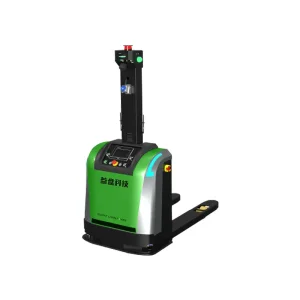
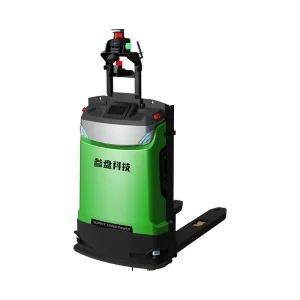
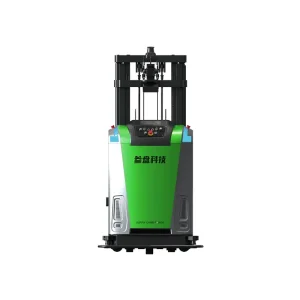
- 1,500 kg (1.5T): SFL-CBD15-ZL horizontal handling pallet truck and SFL-CDD15 narrow-aisle stacker with lift heights up to 3.0 meters.
- 1,600 kg (1.6T): SFL-CBD16-S compact high-speed pallet handler.
- 2,000 kg (2.0T): SFL-CPD20-Y heavy-duty counterbalanced autonomous forklift (1180 mm narrow chassis profile) and SFL-CDD20-Y stacker.
- 300 kg: SFL-300L agile single-wishbone forklift for ultra-confined spaces.
How do the robots handle non-standard, broken, or misaligned pallets?
What battery maintenance protocols are used for multi-shift 24/7 facilities?
What after-sales, warranty, and spare parts support is offered to international buyers?
Specialized Autonomous Forklifts & Transport Platforms
Explore the extended lineup of heavy-duty, narrow-space, and top-lifting automated transport platforms engineered for high-duty production environments.
Modernize Your Palletizing Infrastructure with Confidence
Autonomous material handling is no longer a multi-year civil construction project. By partnering with leading Chinese robotic factories equipped with natural feature Laser SLAM, open software ecosystems, and sub-centimeter hardware, global organizations achieve lights-out warehousing operations with proven ROI metrics.