

Smart Forklifts & AGV Flagship Series
Featured Industrial Autonomous Forklifts & Transport AGVs
Engineered for pallet logistics, high-bay stacking, and horizontal haulage. High-precision Laser SLAM navigation, zero floor infrastructure retrofitting, and seamless MES/WMS dispatch connectivity.

China China Suppliers Laser SLAM Smart Forklift SFL-300L - 300kg Load Capacity, Customizable Extreme Flexibility
Inspect Product Specs
Best China Factory Smart Forklift SFL-CDD15 with Laser SLAM Technology - Narrow Aisle Solution Reliable Suppliers
Inspect Product Specs
Best China Suppliers Factory Laser SLAM Stack-height Smart Forklift SFL-CDD16 - Efficient, Flexible, 1600kg Capacity
Inspect Product Specs
China China Suppliers Factory Laser SLAM Stack-height Smart Forklift SFL-CDD14-H - 1400kg Capacity Slim Design
Inspect Product Specs
China China Suppliers Factory Smart Forklift SFL-CBD16-S: 1.6T Laser SLAM Handling with Cost-Effective Performance
Inspect Product Specs
Best Laser SLAM Stack-height Smart Forklift SFL-CDD16 - Efficient Material Handling Needs Suppliers, Factories
Inspect Product Specs
Best China Suppliers Factory Laser SLAM Small Stack-Height Smart Forklift SFL-CDD14 & SFL-CDD14-CE Narrow Paths
Inspect Product Specs
Industry 4.0 Technical Taxonomy
Automated Guided Vehicle Meaning: Deconstructing the Modern Industrial Definition
From legacy magnetic trace tracks to fully autonomous Natural Feature Laser SLAM robotics, the definition of an Automated Guided Vehicle (AGV) has fundamentally shifted from rigid conveyors to cognitive fleet systems.
Classical AGV (Generation 1 & 2)
Historically, an Automated Guided Vehicle (AGV) denotes an unmanned computer-controlled mobile platform following predefined physical pathways—such as magnetic wire, embedded inductive cables, or retro-reflective optical bar-tapes. While dependable, classical systems suffer from brittle path inflexibility: altering routing requires invasive civil engineering and downtime.
Natural Feature Navigation (Laser SLAM)
Modern AGVs from Chinese Tier-1 innovators utilize simultaneous localization and mapping (SLAM) via LiDAR scanners. By utilizing environmental contour matching without external markers or reflectors, these units match current point clouds with internal 400,000 m² global topological maps, recalculating localized vectors in sub-millisecond intervals.
Convergence: AGV vs. AMR Boundary
The boundary between AGVs and Autonomous Mobile Robots (AMRs) has converged. High-capacity smart forklifts (e.g., SFL-CPD20-Y and SFL-CDD15) integrate industrial pallet fork mechanicals with dynamic obstacle bypass, multi-sensor AI perception, and self-orchestrating traffic managers, delivering the load payload of heavy AGVs with the intelligence of AMRs.
| Guidance Technology | Infrastructure Dependency | Docking Precision | Deployment Agility | Capital Retrofit Overhead |
|---|---|---|---|---|
| Magnetic Tape / Marker Pin | High (Ground slots, magnetic strips) | ±10 mm to ±15 mm | Weeks (Requires civil floor work) | High initial & continuous maintenance |
| Reflector Laser Triangulation | Medium (Pillar/wall target reflectors) | ±8 mm to ±12 mm | Days (Target placement & calibration) | Moderate (Prone to reflector obstruction) |
| Laser SLAM (Natural Contour) | Zero Floor Modification | ±5 mm (Multi-sensor hybrid) | < 24-48 Hours (Direct CAD mapping) | Zero external infrastructure cost |
| Vision / QR Code Grid | High (Ground matrix stickers) | ±3 mm to ±5 mm | Days (Wear & tear re-stickering) | Low setup, high surface attrition |
Sourcing & Procurement Strategy
Global Enterprise Sourcing Demands: Why Procurement Directors Source from China
Evaluating the structural shift in supply chain automation: capital expenditure reduction, compressed return on investment cycles, and advanced manufacturing depth across China's robotics clusters.
Capex vs. Total Cost of Ownership (TCO)
European and North American automation suppliers often demand prohibitive upfront engineering fees, multi-year payback curves, and proprietary software lock-ins. Chinese manufacturers provide tier-one industrial hardware (such as precision gearboxes, drive motors, and Siemens/Phoenix safety relays) at a fraction of the cost, compressing the project breakeven benchmark to under 18 months.
Ecosystem & Rapid Supply Chain Depth
The Chinese industrial ecosystem houses localized manufacturing for core robotics components: LiDAR sensors, drive wheels, mechanical lift masts, battery management systems (BMS), and embedded industrial PCs. This concentration slashes lead times from the typical 6-9 months common in Western robotics to 6-10 weeks, ensuring uninterrupted continuous expansion.
Customizable Engineering Versatility
Unlike rigid catalog distributors, premier Chinese manufacturers provide bespoke chassis geometry, customized fork spread, single-wishbone configurations (e.g., SFL-300L), multi-direction steering, and explosion-proof or cold-storage packages (-25°C rating). This agility ensures zero structural factory refactoring for overseas operations.
Application Engineering
Macro Industry Solutions: Targeted Deployments Across Global Verticals
Scalable automated guided vehicle systems resolve critical logistical friction points across manufacturing, warehousing, cold chains, and retail distribution centers.

Precision Manufacturing
Just-in-Time (JIT) line-side delivery connecting raw material storerooms directly to CNC, welding, and final assembly lines. Eliminates material stockouts and buffer pile-ups.
Zero Line-Side Idle Latency

Logistics & 3PL Hubs
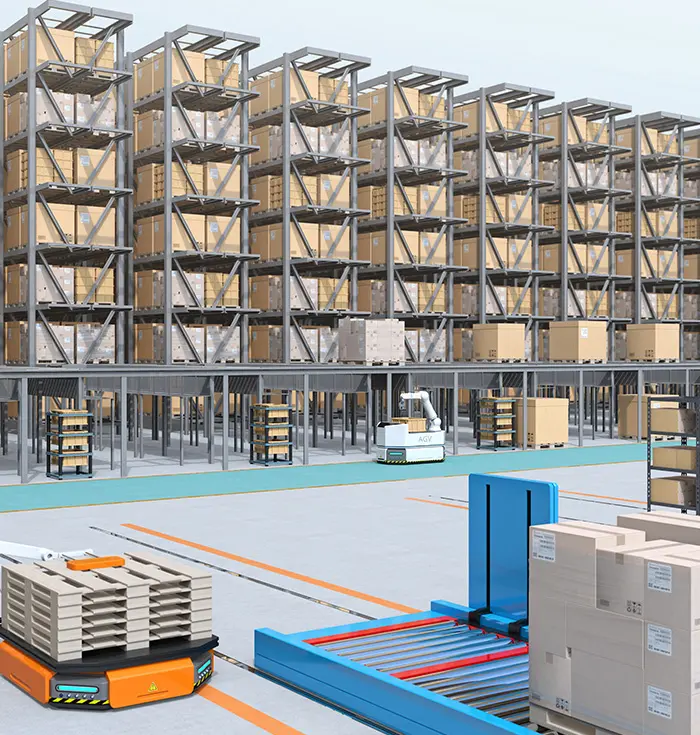
Autonomous pallet truck fleets and counterbalanced smart forklifts (SFL-CPD20-Y) operating 24/7. Cross-docking throughput handles up to 2 m/s travel velocities safely.
> 35% Throughput Elevation

Cold Storage Logistics
Engineered with internal heating elements, low-temperature lithium cells, and anti-condensation optics. Reliably operates down to -25°C where manual forklift driving poses human health hazards.
-25°C Continuous Integrity
FMCG & Retail Fulfillment
Synchronized dynamic floor sorting scales (SCP101/SCP100) integrated with stealth top-lifting robot chassis (AMB-CSW10-BH) for high-density bin picking and shelf replenishment.
99.98% Order Picking Precision
System Engineering Deep-Dive
Full-Stack Autonomy Architecture: SCC Controller & Fleet Brain
Achieving industrial-grade reliability demands tight coupling between edge-computing hardware, real-time robotic operating kernels, and upper-layer enterprise resource orchestration.
SCP SCC Industrial Controller
The physical computational core of the vehicle. Equipped with dual CAN-bus channels, EtherCAT master communication, hardware-level watchdog timers, and IP65 sealing. It processes IMU telemetry, wheel odometry, and safety LiDAR laser planes simultaneously at 100Hz real-time determinism.
Multi-Sensor AI Perception
Equipped with 360-degree safety LiDARs, forward 3D Time-of-Flight (ToF) cameras, and pallet pocket recognition cameras. Advanced deep learning networks recognize variable wood, plastic, and Euro-pallet fork apertures in real time, auto-adjusting tines to compensate for unaligned drops up to ±15 degrees.
Server X Store Fleet Dispatcher
An industrial cluster software managing fleets upwards of 300 autonomous units per facility. Features distributed path routing, topological traffic collision reservation, battery level threshold charging, and bidirectional Open API hooks directly into SAP, Oracle, Manhattan WMS, and custom MES platforms.
Risk Mitigation & Standards
Localization Support, Global Compliance & Engineering Safety
Deploying autonomous robotic systems overseas requires stringent alignment with regional machinery directives, functional safety architectures, and local maintenance service level agreements (SLAs).
Functional Safety: ISO 3691-4 & CE-MD
Reliable Chinese suppliers design AGVs conforming to ISO 3691-4:2023 (Driverless industrial trucks) and EN ISO 13849-1 (PL-d, Category 3 architecture). Dual-channel safe laser scanners, mechanical emergency e-stop loops, active acoustic-optical beacons, and monitored velocity encoders ensure collaborative operation alongside human operators.
VDA 5050 Standard Compliance
To avoid vendor lock-in, advanced vehicles interface via the VDA 5050 standard protocol. This enables a unified, third-party central fleet control system to dispatch heterogeneous autonomous vehicle fleets—mixing pallet jacks, counterbalance tuggers, and mobile robot chassis from multiple OEMs effortlessly.
Global Commissioning & Spares Pool
With deployments across 30+ countries, established manufacturers provide remote telemetry cloud diagnostics, modular swap-and-replace components, and regionally localized partner integrator networks across Europe, North America, Southeast Asia, and the Middle East for responsive onsite field engineering support.
Tier-1 AGV Supplier Due Diligence Checklist
Before entering procurement agreements, international sourcing engineers should verify the following engineering standards with prospective manufacturers:
Safety Architecture
- Dual safety laser scanners with dynamic warning zones
- ISO 3691-4 & ISO 13849-1 (PL-d certified)
- Hardwired safety relays for e-stop circuits
Software & Interfaces
- RESTful API & MQTT protocol support
- VDA 5050 universal compliance
- Simulated digital twin workflow pre-validation
Power & Performance
- Lithium Iron Phosphate (LiFePO4) chemistry
- Automated floor charging contacts (1C rate)
- 2-minute battery quick-swap mechanism
Future Outlook
Technology Roadmap: Next-Generation Autonomous Guided Mobility
Anticipating the technological convergence driving automated material handling from 2025 to 2030: edge AI vision, 5G-Advanced private networking, and swarm intelligence architectures.
Phase 01: Present Core
Reflectorless Laser SLAM
Natural feature recognition matching 2D/3D LiDAR returns with global spatial point-clouds. ±5 mm positioning, sub-second route updates, and zero civil engineering.
Phase 02: 2025-2026
Edge AI Pallet Recognition
Embedded neural network accelerators computing pallet aperture poses, detecting shrink-wrap folds, and actively adjusting fork spread and height during approach.
Phase 03: 2027-2028
5G-A Swarm Coordination
Ultra-low latency microsecond vehicle-to-vehicle (V2V) communication. Eliminates static intersection pauses, allowing dynamic micro-platooning through high-density aisles.
Phase 04: 2029+ Vision
Fully Autonomous Control Towers
Predictive AI scheduling linked with enterprise ERP. Systems pre-position inventory before shift picks begin and auto-rebalance distribution hubs without human dispatches.
Technical & Commercial Diligence
Frequently Asked Questions: Industrial AGV Procurement
Critical operational answers for supply chain directors, factory automation leads, and global procurement managers.
What is the exact engineering difference between an AGV and an AMR?
Traditionally, an Automated Guided Vehicle (AGV) moves along fixed tracks (magnetic striping, reflective optical guide-lines, or buried inductive wire) with basic stop-and-wait collision sensing. An Autonomous Mobile Robot (AMR) uses onboard perception (LiDAR SLAM, stereoscopic 3D vision, IMU) to navigate dynamically around stationary or moving obstacles without physical lines. Today, advanced industrial smart forklifts combine heavy structural AGV chassis load capacities (e.g., 1.5t to 2t) with AMR-level Laser SLAM intelligence, offering dynamic route planning and zero infrastructure installation.
How does Laser SLAM achieve ±5 mm docking precision without floor markers?
Natural feature Laser SLAM utilizes high-frequency pulsed LiDAR beams (typically 10 to 30 Hz) scanning environmental boundaries such as structural columns, walls, racking uprights, and machinery. By calculating scan point-cloud correlation against an internal metric occupancy grid, the system determines its pose $(x, y, \theta)$. During docking maneuvers, secondary fine-tuning algorithms incorporate drive-wheel optical encoder odometry, solid-state IMU readings, and 3D visual aperture recognition to converge on ±5 mm repeatable tolerance.
How long does an industrial site deployment take?
Because Laser SLAM requires zero magnetic cutting, reflective stickers, or ground QR codes, deployment for compatible facilities takes as little as 1 to 2 days. The mobile unit traverses the site via remote joystick to generate an initial 2D/3D topological floor map (covering up to 400,000 m²). Virtual pathways, pickup stations, buffer docks, and speed restrictions are then configured directly within the software GUI, followed by test mission validation.
Can the fleet controller integrate with third-party ERP, WMS, and MES systems?
Yes. Systems utilize open RESTful APIs, WebSocket endpoints, and MQTT broker channels to facilitate bidirectional communication with SAP, Oracle, Manhattan Associates, Blue Yonder, and proprietary legacy databases. Automated pick, put-away, and transfer triggers originate in your WMS/MES and convert into autonomous route tasks inside the dispatch scheduler without manual intervention.
What battery technology and charging models are implemented for continuous 24/7 uptime?
Vehicles leverage industrial Lithium Iron Phosphate (LiFePO4) battery packs, celebrated for extended thermal stability and over 3,000-4,000 cycle lives. Automated opportunity charging floor plates allow vehicles to draw 0.5C to 1C charge rates during idle micro-windows (e.g., operator shift transitions or queue pauses). Alternatively, for continuous operation, quick-swap battery mechanisms enable full manual or automated battery changes in less than 2 minutes.
What safety redundancies protect human personnel working in shared aisles?
Industrial vehicles comply strictly with ISO 3691-4 safety protocols. Safety measures include front and rear safety LiDAR scanners with speed-dependent dynamic detection fields (deceleration zone and emergency stop zone), non-contact 3D obstacle avoidance cameras to identify overhead or low protrusions, mechanical contact safety edge bumpers, optical LED floor projection pathway warnings (blue/red perimeter halos), and dual hardwired E-stop circuits certified to Category 3, PL-d functional safety.
Heavy Duty & Specialized Autonomous Vehicles
Counterbalanced, Stacker & Portable Smart Fleet Lineup
Engineered for diverse industrial pallet weights, multi-shift operating cycles, and challenging factory layouts. Direct manufacturer pricing and export-grade engineering.

China China Laser SLAM Balanced Power Smart Forklift SFL-CPD20-Y Top Suppliers and Factory Direct Price
Inspect Product Specs
China China Suppliers Factory Laser SLAM Stack-height Smart Forklift SFL-CDD20-Y 2T Capacity 10h Battery Life
Inspect Product Specs
Best China Suppliers Factory Laser SLAM Stack-Height Smart Forklift SFL-CDD20-Y with 2000kg Capacity Factory
Inspect Product Specs
China Laser SLAM Balanced Power Smart Forklift SFL-CPD20-Y Factory Direct Heavy Handling Solutions
Inspect Product Specs
China Laser SLAM Single Wishbone Smart Forklift SFL-300L Manufacturers, Reliable Supplier
Inspect Product Specs
China China Suppliers Factory Laser SLAM Smart Forklift SFL-CPD20-Y 2000kg Capacity 6-8 Hour Battery Life
Inspect Product Specs
Best China Laser SLAM Portable Intelligent Forklift - Efficient and Flexible Suppliers from a Reliable Factory
Inspect Product Specs